
Enterprise AI Agents in 2026: From Experimentation to Real Business Operations
In 2026, AI agents are moving beyond simple chatbots to become active participants in business operations. Discover how enterprises are adopting agentic AI, the opportunities it creates, and what businesses should consider before putting autonomous systems into production.
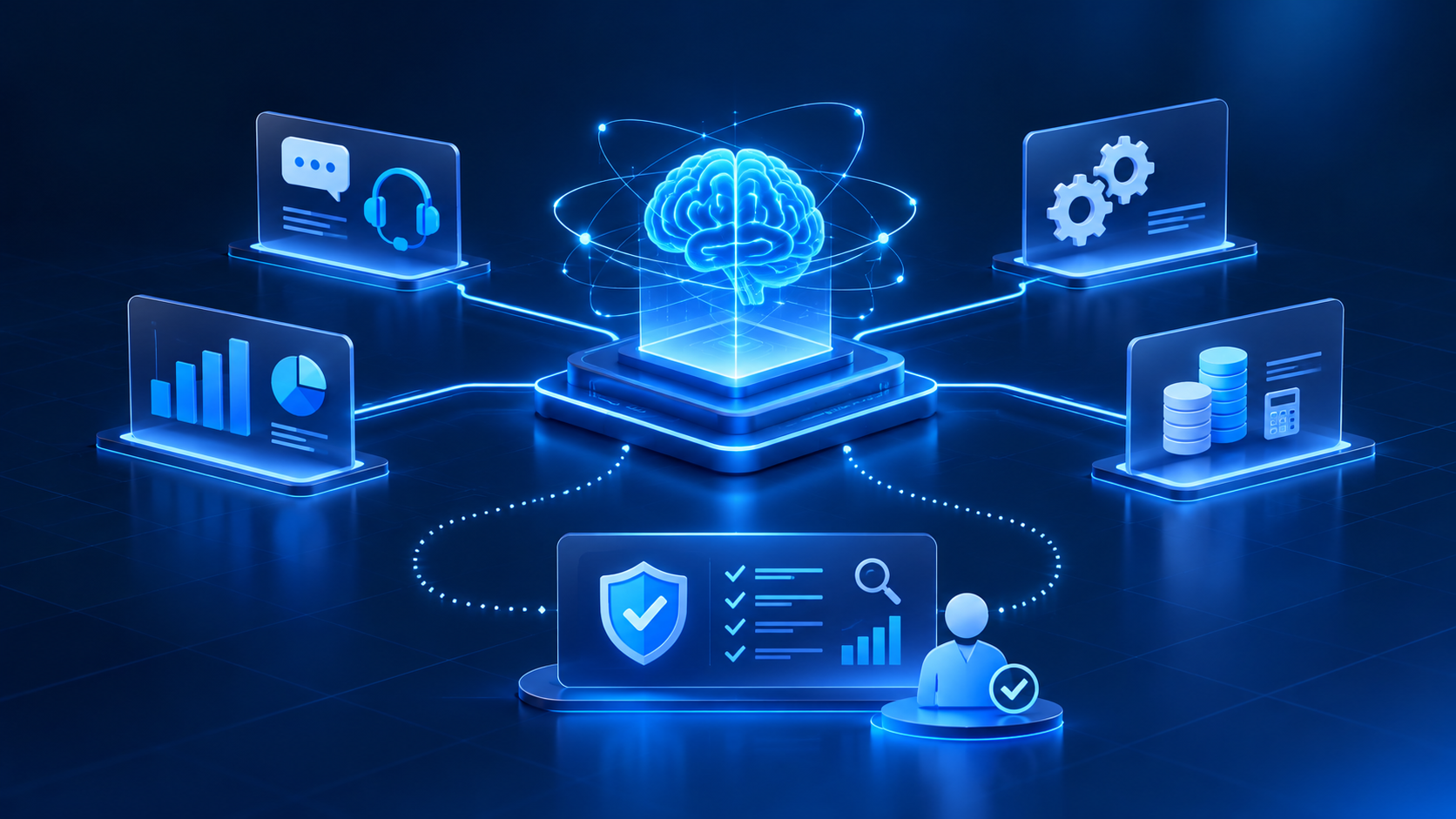
# Enterprise AI Agents in 2026: From Experimentation to Real Business Operations
Artificial Intelligence is entering a new phase. Over the past few years, businesses have become familiar with AI-powered chatbots, content generation tools, and intelligent assistants. These technologies have changed how people interact with information and complete everyday tasks.
But the next development is taking things further.
AI agents are beginning to move beyond answering questions and generating responses. They can now work toward defined objectives, interact with business applications, retrieve information, execute tasks, and coordinate multi-step workflows.
For businesses, this creates an important opportunity: instead of using AI only as a supporting tool, organizations can begin incorporating it directly into their operations.
In 2026, the conversation is shifting from experimenting with AI agents to understanding how they can be deployed reliably, securely, and at scale.
What Are Enterprise AI Agents?
An AI agent is an intelligent software system designed to understand a goal, determine the steps required to achieve it, and use available tools or information to carry out those steps.
Unlike a conventional chatbot that primarily responds to individual prompts, an AI agent can work through a sequence of activities. Depending on its design and permissions, it may retrieve information, interact with APIs, update records, trigger workflows, and report the outcome.
For example, consider a customer who submits a service request.
A traditional chatbot might answer frequently asked questions or direct the customer to a support representative. An AI agent could go further by:
- Understanding the customer's request and identifying the issue.
- Retrieving relevant information from the company's knowledge base.
- Checking the customer's account or service history.
- Creating a support ticket in the CRM.
- Assigning the request to the appropriate department.
- Following up and notifying the customer about the progress.
The agent does not simply generate a response. It participates in a broader business process.
The exact level of autonomy depends on the tools, integrations, permissions, and approval requirements configured by the organization.
Why Are Businesses Paying More Attention to AI Agents in 2026?
Enterprise adoption is becoming increasingly visible.
According to Zapier's November 2026 survey of 513 enterprise leaders at organizations with at least 1,000 employees, 88% said their organizations were using or testing AI agents. The survey also reported that 71% had agents in production, compared with 40% in 2025.
These figures indicate growing interest in moving agentic AI into operational environments. However, adoption does not automatically mean that every organization has achieved fully autonomous operations.
The business interest is driven by several practical opportunities.
1. Reducing Repetitive Work
Many business processes involve activities that are necessary but time-consuming.
Data entry, document classification, information retrieval, report preparation, appointment coordination, and internal requests often require employees to move between multiple applications.
AI agents can help manage these activities by retrieving relevant information and executing approved steps within existing workflows.
This allows employees to spend more time on activities that require judgment, communication, and problem-solving.
2. Improving Customer Support
Customer expectations continue to evolve. People increasingly expect quick responses and consistent service across different communication channels.
AI agents can support customer service teams by understanding requests, retrieving relevant answers, checking customer information, creating support tickets, and escalating complex cases.
For example, an agent connected to a company's CRM and knowledge base could help resolve routine enquiries while transferring sensitive or complicated matters to a human representative.
The objective is not necessarily to eliminate human support. It is to help support teams handle requests more efficiently.
3. Connecting Disconnected Business Applications
Businesses often use different platforms for sales, marketing, finance, customer support, project management, and operations.
When these systems do not communicate effectively, employees spend considerable time transferring information between them.
AI agents can connect with approved applications through APIs and integrations, helping information move between systems as part of a coordinated workflow.
For instance, when a sales enquiry arrives, an agent could collect the relevant details, enrich the lead using approved business data, create a CRM record, and notify the appropriate sales representative.
4. Supporting Better Business Decisions
AI agents can help teams collect information from multiple sources, summarize findings, identify patterns, and prepare reports.
A business intelligence agent, for example, could retrieve sales information, compare performance across reporting periods, highlight unusual changes, and prepare a summary for management.
Human decision-makers can then use these insights to investigate issues and determine the appropriate next steps.
Where Can Enterprise AI Agents Be Used?
AI agents are not limited to one department or industry. Their applications depend on the organization's processes, available data, and technology infrastructure.
Here are some practical examples.
Sales and Marketing
Sales teams can use AI agents to:
- Organize and qualify incoming leads.
- Research prospective customers using approved sources.
- Prepare personalized outreach drafts.
- Update CRM records.
- Schedule follow-up activities.
- Generate sales performance summaries.
For example, a lead management agent could review incoming enquiries, categorize them based on predefined criteria, and notify the appropriate sales representative.
Customer Service
Customer support agents can help with:
- Responding to routine enquiries.
- Retrieving information from knowledge bases.
- Classifying support tickets.
- Checking order or service status.
- Routing complex requests to the right team.
- Preparing responses for human approval.
Finance and Administration
Within carefully controlled environments, AI agents can support:
- Invoice information extraction.
- Expense categorization.
- Document verification.
- Financial report preparation.
- Payment reminder drafting.
- Internal approval workflows.
Financial transactions and other sensitive actions should remain subject to appropriate authorization and human controls.
IT and Software Development
Technology teams can explore AI agents for:
- Monitoring application alerts.
- Analyzing error logs.
- Preparing incident summaries.
- Supporting software testing.
- Reviewing code changes.
- Managing routine development tasks.
Production changes, access modifications, and other high-impact activities should require appropriate safeguards and approvals.
From Individual AI Agents to Multi-Agent Systems
Another important development is the emergence of multi-agent systems.
Rather than expecting one agent to perform every task, organizations can design multiple specialized agents that collaborate through a coordinated workflow.
Consider an e-commerce business managing customer orders.
A multi-agent system could include:
Order Agent: Receives and understands incoming orders.
Inventory Agent: Checks product availability and inventory information.
Customer Support Agent: Handles customer enquiries and prepares updates.
Analytics Agent: Analyzes order patterns and prepares operational reports.
An orchestration layer coordinates these agents, manages the sequence of activities, and ensures that information is passed between them appropriately.
This approach can make complex workflows easier to organize, but it also introduces additional requirements around communication, permissions, error handling, and monitoring.
More agents do not automatically mean better results. The architecture should be based on the actual business process.
What Should Businesses Consider Before Implementing AI Agents?
The potential is significant, but moving an AI agent from a demonstration to a dependable business application requires planning.
A successful implementation involves more than selecting an AI model.
1. Start With a Clearly Defined Business Problem
Businesses should identify a specific process that consumes time, involves repetitive work, or creates operational bottlenecks.
Instead of beginning with the question, "Where can we use AI?", start by asking, "Which business problem are we trying to solve?"
A well-defined use case makes it easier to evaluate the solution and measure its impact.
2. Ensure Data Quality and Accessibility
AI agents depend on information to understand context and perform tasks.
If business information is outdated, incomplete, duplicated, or spread across disconnected systems, the agent may produce unreliable results.
Organizations should evaluate their data sources, knowledge bases, APIs, and application integrations before deployment.
3. Establish Permissions and Governance
An AI agent should only have access to the information and actions necessary for its assigned responsibilities.
Businesses should define:
- Which applications the agent can access.
- What information it can retrieve.
- Which actions it is permitted to perform.
- Which activities require human approval.
- How its actions are recorded and reviewed.
Sensitive activities should have stricter authorization requirements.
4. Keep Humans Involved Where Necessary
Autonomy should be introduced gradually.
An agent might be allowed to categorize support requests independently but require human approval before issuing refunds or changing customer account information.
Similarly, an agent may prepare a financial transaction for review without being authorized to execute it.
The objective is to combine the speed of automation with human judgment and accountability.
5. Monitor Performance and Reliability
An AI agent that works well during testing may behave differently when exposed to real-world data and changing business conditions.
Organizations should monitor accuracy, completion rates, response quality, execution failures, costs, and human intervention.
Regular evaluation helps teams identify problems and improve the system over time.
The Challenges of Moving AI Agents Into Production
Despite growing adoption, several challenges remain.
Reliability: AI agents can misunderstand instructions, retrieve incorrect information, or take unsuitable actions. Testing and monitoring are essential.
Security and privacy: Agents connected to business applications may access sensitive information. Organizations need controlled access, secure integrations, and appropriate data protection practices.
Integration complexity: Connecting an agent to existing software, databases, and workflows can require considerable engineering effort.
Cost management: Model usage, infrastructure, integrations, monitoring, and maintenance all contribute to the overall cost of deployment.
Accountability: Every business needs clarity about who owns an agent, who authorizes its actions, and who is responsible when something goes wrong.
These challenges do not make agentic AI impractical. They highlight why thoughtful engineering and governance are essential.
How Businesses Can Start Their AI Agent Journey
Organizations do not need to automate their entire operation at once.
A practical approach is to begin with a focused workflow and expand gradually.
Step 1: Identify an opportunity. Select a repetitive, measurable business process where AI agents could provide meaningful assistance.
Step 2: Map the workflow. Document the systems, data sources, people, approvals, and activities involved.
Step 3: Build a focused solution. Develop an agent with clearly defined responsibilities, approved tools, and limited permissions.
Step 4: Test with real-world scenarios. Evaluate its responses, actions, exceptions, and ability to handle unexpected inputs.
Step 5: Introduce controlled deployment. Start with human supervision and gradually expand autonomy when the system demonstrates reliable performance.
Step 6: Measure and improve. Review business outcomes, user feedback, operational performance, and maintenance requirements.
This incremental approach helps organizations learn from practical experience before extending AI agents to more complex operations.
The Future of Enterprise AI Is About More Than Automation
AI agents represent an important evolution in how businesses can use artificial intelligence.
The opportunity is no longer limited to generating content or answering questions. Organizations can begin designing intelligent systems that participate in workflows, interact with business applications, and support teams in completing complex tasks.
However, the organizations that benefit most will not necessarily be those that deploy the largest number of agents. They will be the ones that identify meaningful use cases, establish reliable integrations, maintain appropriate controls, and continuously evaluate business outcomes.
The shift from AI experimentation to real business operations is already underway. For businesses, the next step is to understand where intelligent agents can create measurable value and how to introduce them responsibly.
At Xylisys, we work with businesses to explore and develop AI-powered applications, intelligent agent solutions, workflow automation, and custom software tailored to operational needs.
If your organization is exploring how AI agents could improve its business processes, the right starting point is a clear understanding of the problem, the workflow, and the outcome you want to achieve.
Explore intelligent AI solutions with Xylisys: https://xylisys.com/